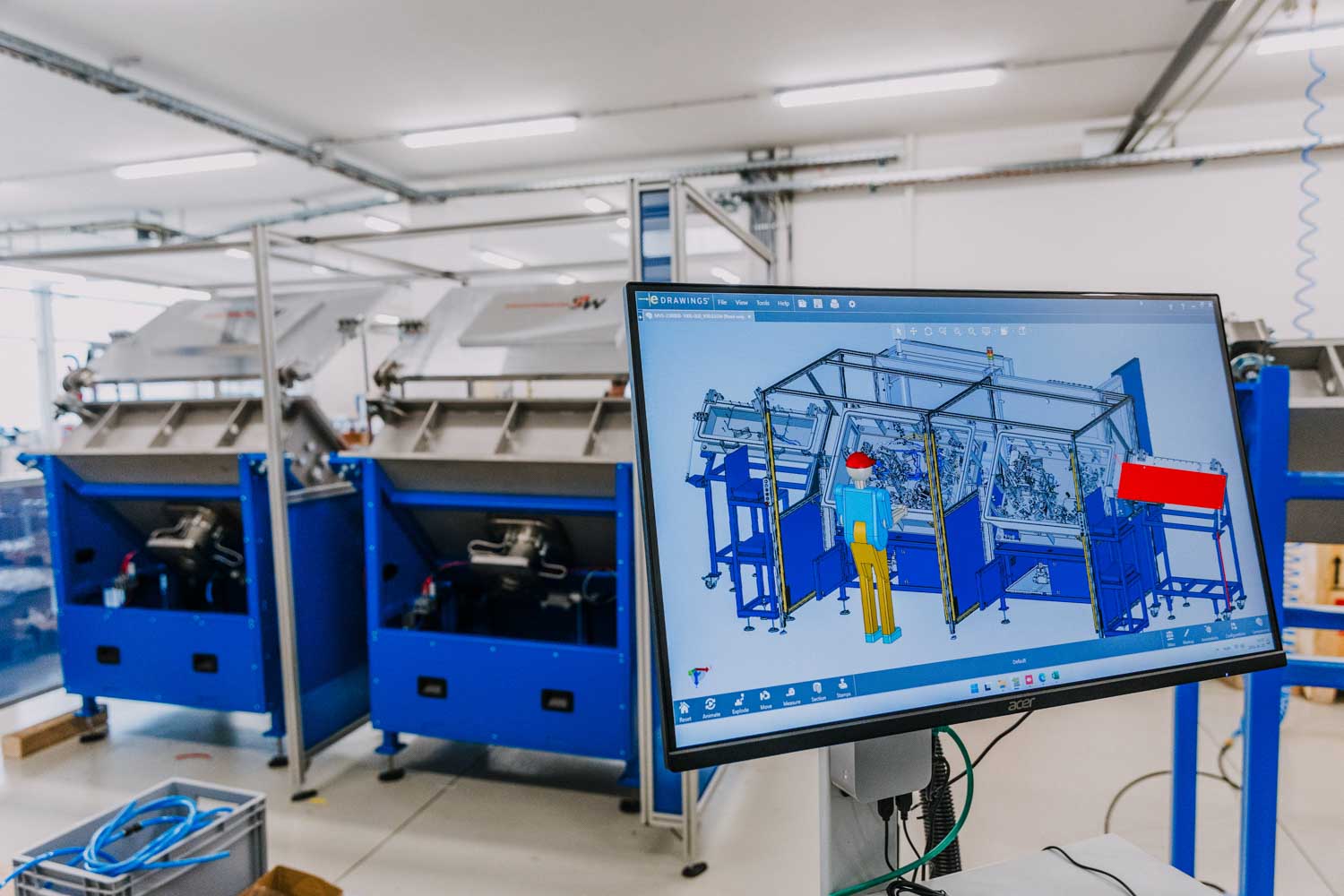
A few hundred metres from the Atlantic coast in Portugal, MVS Technologies once installed a leak testing system in a production hall that was still under construction. This happens more often than outsiders expect. Large machines frequently go in before the last wall closes, because an open side is the most practical way to get them inside. Until the building was finished, humid, salty sea air reached the equipment directly. Moisture condensed on every cool surface, and the saline air started to attack the rubber seals.
That project shaped how the company's engineers approach site conditions, and the lesson applies well inland too. A helium leak tester spends its working life in one hall and one climate, shift after shift, and that hall becomes part of every measurement it takes. Machines from MVS Technologies run in Portugal, Turkey, Morocco and Mexico, among many other markets. Wherever a system is headed, heat and humidity belong in the design brief with the same weight as cycle time and test pressure.
Humidity: the variable inside the vacuum chamber
Of all the site conditions, humidity affects leak tester performance most directly, and manufacturers often underestimate it.
Every test cycle begins by evacuating the chamber. Each time the chamber opens for loading, water vapour from the hall settles on its inner walls, and once the pressure drops, that water starts to outgas. In an article on humidity in vacuum systems, vacuum specialist Phil Danielson describes water vapour as perhaps the most common problem in his field, because it returns with every pumpdown. He also identifies elastomer O-rings as one of its major sources. A companion piece explains the mechanism: the amount of water a surface adsorbs depends on relative humidity and exposure time, and its slow release is the main reason pumpdowns stretch out.
On the production floor, the effect shows up in cycle time. Based on MVS Technologies' field experience, a chamber that pumps down in 10 seconds under normal conditions can need several seconds more in a very humid hall. On a line with a tight takt time, those seconds add up over every shift.
The extreme case goes further. Picture a machine standing idle over a weekend in a humid hall without climate control. By Monday morning, moisture covers the chamber surfaces, and the first pumpdown can take five to ten times longer than usual. At that point, the water load is affecting how the machine runs, and the lost seconds become the smaller concern. For humid sites, from coastal Portugal to parts of Mexico and Turkey, MVS Technologies addresses this behaviour at the very first design review.
Coastal sites bring an extra complication. When salty moisture outgasses, the water leaves and the salt can stay behind in the chamber. ISO 9223, the international standard for atmospheric corrosivity, lists airborne salinity and relative humidity among its key parameters, so the two problems feed each other. For these installations, MVS Technologies specifies stainless steel throughout, chooses seal materials that cope with humid, saline air and shortens the seal maintenance interval.
Heat: decisions inside and outside the electrical cabinet
Many production floors are air-conditioned. A good number are not, and in some of those the temperature reaches 40 °C in the shade. A leak tester installed there still has to deliver the results it would give in a climate-controlled plant.
The machinery electrical standard IEC/EN 60204-1 sets correct operation between +5 °C and +40 °C as the minimum requirement for electrical equipment, and it recommends additional measures for hot climates. A hall at 40 °C sits exactly on that limit. The expected ambient temperature therefore goes straight into the sizing of the electrical cabinet and into the decision on whether the cabinet needs its own climate control.
Components mounted outside the cabinet raise a separate question. They sit in the open hall at full ambient temperature, so the engineering team works through them one by one and decides how to specify and protect each. Individually, these are small decisions. Made on the drawing board, they cost far less than a retrofit after commissioning.
Temperature swings and calibration
For measurement accuracy, a fluctuating temperature matters more than a high but steady one.
Helium leak testers are calibrated with gas, and the dynamic viscosity of any gas changes with temperature. When the ambient temperature shifts, the calibration gas behaves differently, and the reference the machine uses to judge each part moves with it. Reference leaks show how temperature-sensitive helium measurement can be. NIST, the US National Institute of Standards and Technology, routinely measures helium leak artefacts across 0 to 50 °C, because the leak rate of a permeation-type reference leak can vary by as much as 4% per degree.
In MVS Technologies' experience, once the temperature has moved more than about 3 to 5 °C since the last calibration, proper validation starts to suffer, and larger swings can become critical. Desert climates produce far bigger ones. Teaching material from the University of Leeds records Saharan daytime maxima of 57 °C, with night-time temperatures falling as low as 2 °C. In Morocco's inland and desert regions, a gap of 30 to 40 °C between afternoon and night is realistic. For a plant producing around the clock, that turns into a serious engineering challenge.
The answer from MVS Technologies is to treat temperature as a monitored variable of the measurement itself. A temperature sensor sits on the machine, and the calibration and validation routine takes its reading into account. An alarm limit, set for example at 3 to 5 °C, tracks the change since the last calibration. When the reading crosses that limit, the machine reports that the temperature has drifted too far and requests recalibration.
Recalibration runs automatically. The operator loads the master part, and the system handles the rest. Nobody needs to log temperatures or judge when conditions have drifted, since the machine watches for it continuously.
The gas supply: a variable outside the machine
A sensor beside the machine covers part of the problem. The helium supply can bring in another.
MVS Technologies usually recommends keeping the tester and the gas storage in separate locations, because of background helium. Ordinary air contains about five parts per million of helium, and a US patent on helium leak testing points out that system leaks or poor venting can push the background above that level and cause false results. Cylinder changes are a frequent source of small leaks, and a leaking storage installation can saturate the air around it. Before every measurement, the machine checks the background level. If ambient helium exceeds the product's reject threshold, the system stops, because the environment can no longer support a reliable result.
Separation removes that risk and creates environmental factors of its own. The gas store may end up at the far end of the plant in an area without air conditioning, with cylinders at 40 °C while the tester works in a hall held at 24 °C. The sensor on the machine reads 24 °C, yet the gas arriving in the chamber can be considerably warmer.
The usual recommendation is a validation at the start of every shift, more often where conditions demand it. The temperature of the gas storage unit can also be measured and built into the process. Most important of all, MVS Technologies maps these variables together with the customer before the system is built.
Closer to home than it looks
Distant markets have no monopoly on this. In Hungary, MVS Technologies has seen a hall without climate control reach 30 °C in the afternoon and drop to 17 °C by evening. For a plant running 24 hours a day, that is the same phenomenon in a narrower band, and it still affects calibration stability. Cooling adds a second effect. Once metal surfaces fall below the dew point, moisture condenses as liquid water, which feeds straight back into the outgassing problem described above.
Any plant without climate control on the production floor should treat ambient conditions as a design input, wherever it happens to be.
Plan for the environment at point zero
Heat, humidity, temperature swings and gas supply are cheapest to account for at the very start of a project, before the first drawing is fixed. IEC/EN 60204-1 says much the same: where site conditions go beyond its standard limits, it recommends an agreement between user and supplier on the physical environment.
For procurement and quality teams, this puts the environment into the specification, alongside the leak-rate target and the other process figures. A tester can meet every number at factory acceptance and still struggle on site if nobody asked what the hall looks like at 3 a.m. in July. Recording those conditions at the outset gives the supplier a design basis and the quality team a validation baseline.
When you plan a new system, bring the site into the conversation from the first day. Tell us about the local climate, whether the floor is air-conditioned, where the helium will be stored and how many shifts the line will run. MVS Technologies engineers every system around those conditions.
Get in touch with MVS Technologies to discuss your next project and the environment it will have to handle.