Gas-insulated switchgear occupies a peculiar position in electrical infrastructure: the sealed, gas-filled compartment that makes it so effective in space-constrained substations is also the point at which it is most vulnerable. Reliable performance stands or falls on the integrity of that seal. Any loss of containment risks dielectric breakdown, unplanned outages, and the release of a greenhouse gas far more potent than carbon dioxide. For manufacturers, leak testing is therefore not a routine quality check but a fundamental product requirement, and helium leak testing has become one of the principal methods GIS manufacturers use to verify enclosure integrity.
Demand for GIS continues to grow as grids modernise, renewable generation expands, and substations are increasingly sited in urban areas where space is at a premium. At the same time, regulations governing insulating gases are tightening. Together, these pressures mean that manufacturers can no longer treat leak testing as an afterthought.
Why is gas-insulated switchgear harder to test than most industrial equipment?
Few products combine as many testing challenges as gas-insulated switchgear. Internal geometry is complex, test pressures can be considerable, and the equipment is often large and heavy, which complicates handling and fixture design. Units destined for ATEX-classified environments add an additional layer of constraint: the test system itself must meet strict safety requirements before it can be used.
The insulating gases used in GIS further complicate matters. SF6 has long been the industry standard, but manufacturers are now moving towards alternatives such as clean-air and fluoronitrile-based mixtures. Regardless of the fill gas, the enclosure must be proven gas-tight, and the test method must deliver reliable, repeatable results across all variants. Generic testing approaches simply cannot meet that standard.
Why is helium leak testing the preferred method for GIS?
Of all available detection methods, helium leak testing offers by far the highest sensitivity, and for GIS, that sensitivity is not a luxury. Helium has the second-smallest atomic size of any element, which means it finds its way through microscopic defects that coarser methods would miss entirely. It is inert and non-toxic, so it can be used safely on any material without risk of reaction. Because helium occurs only in trace amounts in the atmosphere, background noise is minimal, allowing a mass spectrometer to register even the smallest quantity escaping from a test piece. For particularly demanding GIS applications, acceptance criteria may extend into the 10⁻⁸ mbar·l/s range, depending on the enclosure design, operating conditions and applicable standards.
The alternatives fall short in ways that matter for switchgear. A pressure-decay test can confirm that a component holds pressure over time, but it cannot reliably locate or quantify a very small leak, and it is sensitive to temperature and volume effects that introduce measurement uncertainty. Sniffing for the fill gas once the unit is charged comes far too late in the process and lacks the resolution that qualification demands. For switchgear that must remain sealed for decades, and whose failure carries both safety and environmental consequences, helium mass spectrometry is the method that holds up to scrutiny, technically and in front of an auditor.
GIS manufacturing quality control: the real production challenges
Selecting the right test method is only the starting point. The harder question is how to build that capability into a production environment without sacrificing throughput, traceability, or flexibility.
Cycle time is where the tension tends to surface first. Helium testing is sensitive, but sensitivity requires time, and a production line cannot wait indefinitely for a result. A well-designed system resolves this by optimising chamber volume and test sequence so that detection thresholds are met without holding up the line. Chamber volume also matters from a second perspective: the closer it matches the component, the less helium each cycle consumes and the sharper the resulting signal.
Product variety presents its own difficulties. A manufacturer rarely builds a single GIS model, so adapters, fixtures, and test recipes must switch cleanly between variants, ideally with automatic recognition so that the correct parameters load every time and the scope for operator error is removed.
Test data must also be defensible. In the energy sector, a result is only as valuable as the record behind it. MVS Technologies builds digital logging and full traceability into its systems, integrating with existing ERP and MES infrastructure so that every test ties back to the component, its parameters, and the calibration behind it. That level of documentation is precisely what quality assurance and compliance with international energy standards require.
MVS Technologies engineers each system around these realities rather than around a standard template. Chamber size, test pressure, automation level, and component geometry are all configured for the specific application - including systems designed for ATEX environments - and the same engineering depth covers GIS alongside fuel cells, battery enclosures, transformers, and other high-voltage components.
EU F-Gas Regulation 2024/573 and what it means for switchgear manufacturers
The regulatory case for rigorous GIS leak testing has grown considerably stronger in recent years. SF6 is the most potent greenhouse gas currently identified, with a global warming potential around 24,300 times that of carbon dioxide over a hundred-year period and an atmospheric lifetime measured in millennia. A single kilogram escaping from a switchgear unit carries a climate cost entirely disproportionate to its physical size.
The European Union addressed this with the revised F-Gas Regulation (EU) 2024/573, which entered into force in March 2024. The regulation sets binding phase-out dates for F-gases in new switchgear, staged by voltage class. The timeline below summarises the key deadlines:
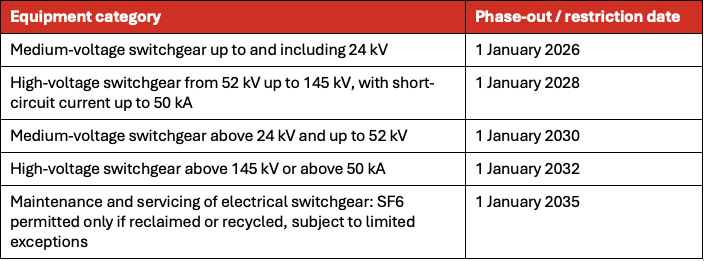
Operators are also required to prevent leaks and maintain records. Relief from routine leak checks is only available where equipment is demonstrably very tight or continuously monitored.
It would be a mistake to read this as the end of leak testing in the GIS world. Moving away from SF6 does not relax the requirement for a hermetically sealed enclosure; if anything, it raises the bar, because alternative gases must be contained just as reliably, and permitted leak rates are tightening. Whether a unit is filled with SF6 or a low-GWP alternative, the manufacturer must still prove the enclosure is tight before it ships. Helium leak testing remains the most dependable way to do that during production, and manufacturers who treat it as a strategic capability rather than a compliance formality will be far better positioned for the regulatory environment now taking shape.
A long-term partner for switchgear manufacturers
For GIS manufacturers, selecting a leak testing partner is a decision with consequences well beyond the purchase of a single machine. With more than 30 years of focused expertise in vacuum technology and helium leak detection, and ISO 9001-certified processes behind every build, MVS Technologies designs systems that align with how manufacturers actually work. That involvement begins in the design phase and continues through installation, operator training, calibration, maintenance, and upgrades, so that detection performance remains reliable across the full working life of the equipment.
Sustainability sits within the same frame. Where helium consumption is significant, MVS Technologies pairs its testers with Helium Recovery Units (available as integrated modules or standalone systems) that reclaim up to 95% of the helium used during testing. These units convert a recurring gas cost into a near-closed loop while supporting ISO 14001 environmental objectives, a consideration that is growing in relevance for an industry under close regulatory scrutiny.
If your organisation manufactures gas-insulated switchgear or other high-voltage components, get in touch with MVS Technologies to discuss a leak detection system engineered around your components, your production flow, and the standards your sector demands.