In modern manufacturing, ensuring product integrity is not merely a quality control measure but a fundamental requirement for safety, regulatory compliance, and long-term reliability. Leak detection plays a critical role across industries, including automotive and aerospace, HVAC, medical devices, and energy systems. Understanding the various testing methods available helps manufacturers make informed decisions about which approach best suits their specific production requirements.
Why leak detection matters
Undetected leaks can lead to catastrophic consequences. In the automotive sector, a compromised fuel line or battery enclosure poses serious safety risks. In aerospace, even the smallest leak in a hydraulic system can result in critical failure under extreme conditions. For HVAC manufacturers, refrigerant leaks not only reduce system efficiency but also contribute to environmental harm through greenhouse gas emissions. The cost of failure, whether measured in recalls, warranty claims, or reputational damage, far exceeds the investment in proper leak testing infrastructure.
Helium-based leak testing has emerged as the gold standard for high-sensitivity applications because of helium's unique physical properties. Its small atomic size allows it to penetrate the tiniest defects, while its inert nature and low atmospheric concentration make it an ideal tracer gas for precision testing.
Overview of leak detection methods
Sniffing test
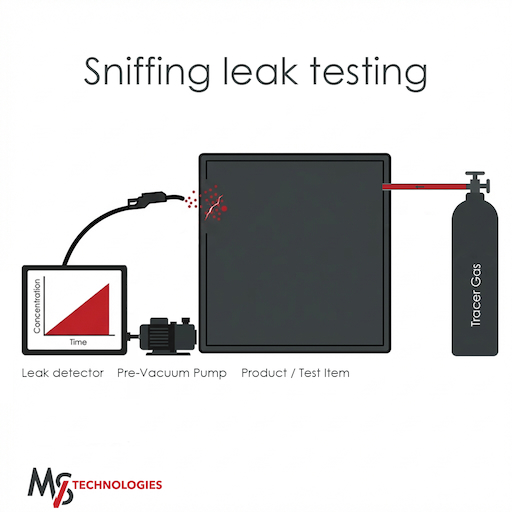
The sniffing test is one of the most straightforward approaches to leak detection. The component under test is filled with a tracer gas, typically helium or a helium mixture. If any leaks exist, the gas escapes through the defect and is detected by a handheld or automated sniffer probe positioned near potential leak points. This method works particularly well for localising leaks in accessible components and is often used as a secondary check after initial screening.
Spraying test
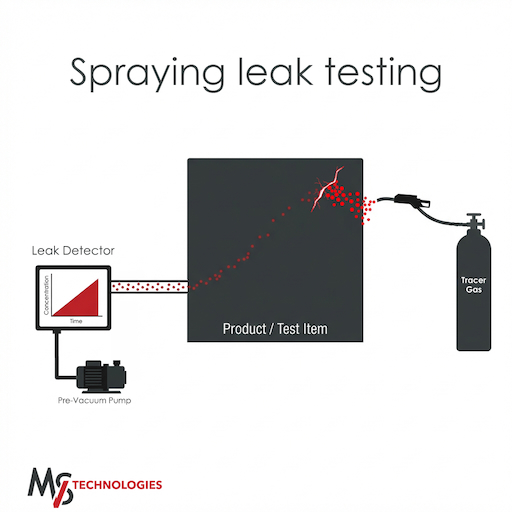
In contrast to the sniffing method, the spraying test begins by creating a vacuum inside the test component. A spray probe then distributes the tracer gas over the part's external surface. If a leak exists, the gas penetrates through the defect into the evacuated interior, where a mass spectrometer detects it. This technique proves especially useful for components with complex geometries where internal pressurisation might be impractical or even impossible.
Bombing Test (Gross Leak Testing)
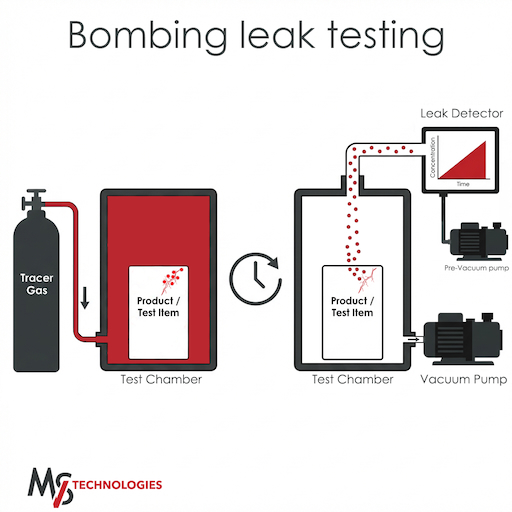
The bombing method addresses a specific challenge: testing sealed components that cannot be connected directly to a leak detector. The process involves placing the sealed part in a pressurised chamber filled with helium. During the pressurisation phase, helium enters the internal volume of the component through existing leak paths. This method is commonly employed for hermetically sealed electronics, sensors, and medical implants.
Accumulation test
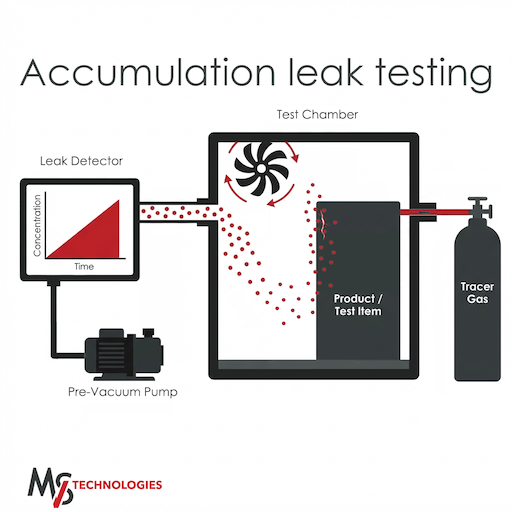
For applications requiring total leakage rate measurement, the accumulation test offers an effective solution. The test item is placed inside an enclosed accumulation chamber and filled with tracer gas. Any gas that escapes through leaks accumulates in the chamber, where internal fans evenly distribute it. A leak detector then measures the total concentration of escaped gas, providing a comprehensive assessment of the component's overall integrity. This approach works well for complex assemblies where pinpointing individual leak locations is less critical than confirming total leak rates remain within acceptable limits.
Hard vacuum leak test
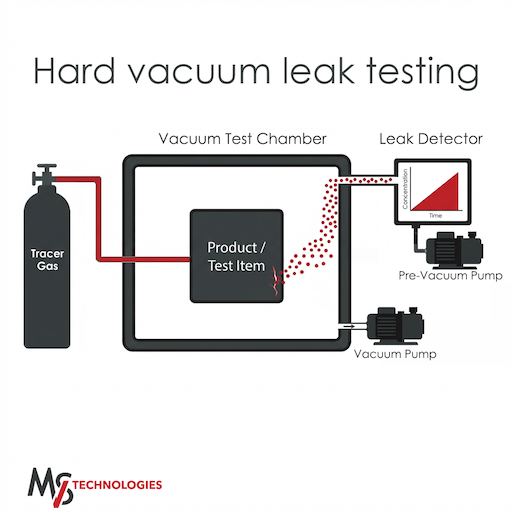
The hard-vacuum leak test is one of the most sensitive detection methods available. The component is filled with helium and placed inside a vacuum chamber. In the event of a leak, the helium escapes into the chamber and is immediately detected by a connected helium mass spectrometer. This method achieves exceptional sensitivity, capable of detecting extremely small leak rates, making it indispensable for safety-critical applications in aerospace, energy storage, and critical automotive systems.
Pressure decay test
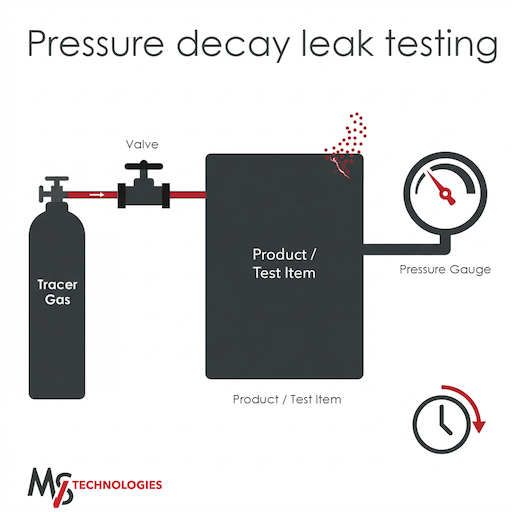
The pressure decay method offers a cost-effective alternative for applications where ultra-high sensitivity is not required. The test item is filled with compressed air until it reaches a specified target pressure. The air supply is then isolated, and the system monitors any pressure drop over a defined period. The rate of decay indicates the presence and severity of leaks. While less sensitive than helium-based methods, pressure decay testing provides rapid, economical screening suitable for high-volume production environments.
Selecting the right method for your application
Choosing the appropriate leak detection method depends on several factors: required sensitivity level, component geometry, production volume, cycle-time constraints, and budget considerations. Many manufacturers find that a combination of methods provides optimal results, using faster screening techniques for initial checks and reserving high-sensitivity helium testing for final verification.
The component's physical characteristics also influence method selection. Large-volume, low-pressure parts such as fuel tanks and battery enclosures require different approaches than small, high-pressure components like valve assemblies or compressor housings. Similarly, production environment constraints, whether cleanroom requirements, automation integration needs, or sustainability targets, all factor into the decision.
MVS Technologies: tailored solutions for every industry
At MVS Technologies, we recognise that no two manufacturing challenges are identical. With over thirty years of experience in designing and manufacturing custom helium leak detection and vacuum systems, we have developed deep expertise across a diverse range of industries and applications.
Whether your requirements involve automotive fuel systems, EV battery enclosures, aerospace hydraulic modules, HVAC compressors, medical device housings, or energy sector components such as hydrogen tanks and gas-insulated switchgear, MVS Technologies delivers bespoke solutions engineered to your exact specifications. Our systems accommodate test pressures, chamber sizes optimised for your component geometry, and cycle times aligned with your production throughput requirements.
Our engineering team works closely with each partner to understand their specific testing challenges and regulatory requirements. From initial consultation through system design, installation, operator training, and ongoing maintenance, we provide comprehensive lifecycle support that ensures sustained performance and maximum uptime.
MVS Technologies stands ready to help you navigate these decisions and implement solutions that protect your products, your customers, and your reputation. No matter your industry or challenge, we deliver precision-engineered, tailor-made leak detection systems that ensure every component leaving your production line meets the highest standards of integrity.
To discuss your leak detection requirements or learn more about our custom solutions, contact MVS Technologies at info@mvs-systems.com or visit http://mvs-systems.com/contact